Quantitative Analysis
In September 2025, we went to Yuanlin Performance Hall to interview audience members who came to watch the Pingpengcao Theater's annual major performance. We conducted a questionnaire survey. The questionnaire had three main parts: basic information, the content of the play, and the local theater troupe. There were a total of 20 questions.
Part 1 Basic Information Questions 1–6
1Age Analysis
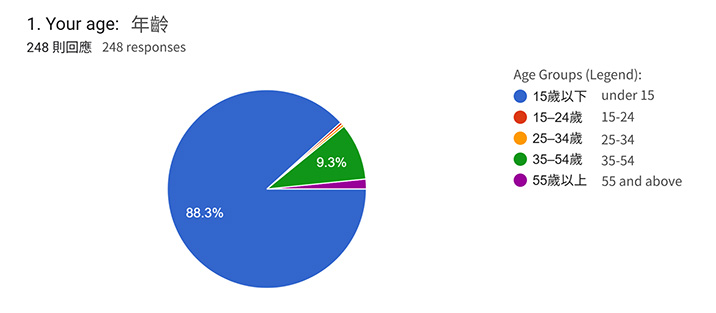
Most of the respondents were under 15 years old (88.3%), followed by those aged 35–54 (9.3%).
2Gender Analysis
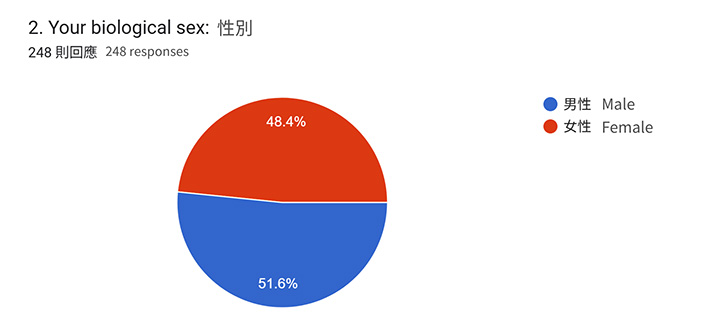
The respondents were about equally male and female. There were 128 males (51.6%), slightly more than 120 females (48.4%).
3Residence Analysis
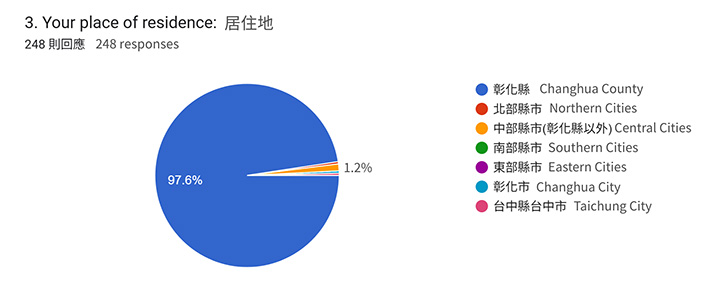
Most of the respondents lived in Changhua County, showing that this survey mainly reflects the opinions and characteristics of residents in the Changhua area, with a clear regional focus. The next most common locations were counties near Changhua in central Taiwan.
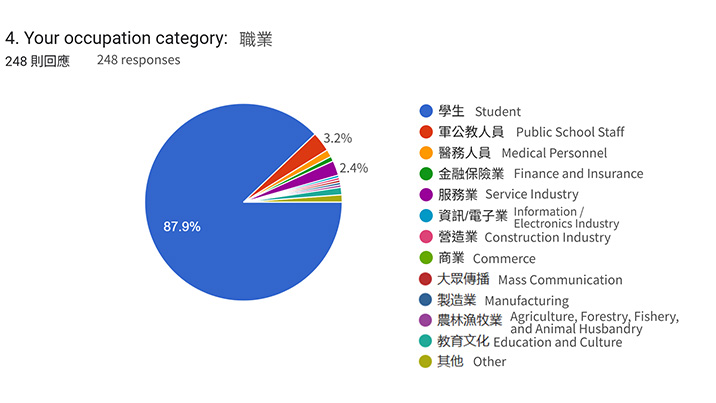
4Occupation Analysis
Most of the respondents were students, showing that the results of this survey mainly reflect the views and experiences of the student group.
5Education Level Analysis
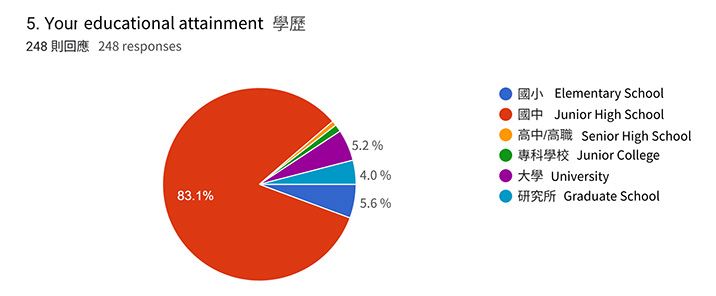
Most respondents were junior high school students, making up 83.1% of the sample, showing that the questionnaire mainly targeted junior high students. The next largest groups were university students (5.2%) and graduate students (4.0%), while other education levels accounted for a smaller proportion.
6Exposure to Performing Arts
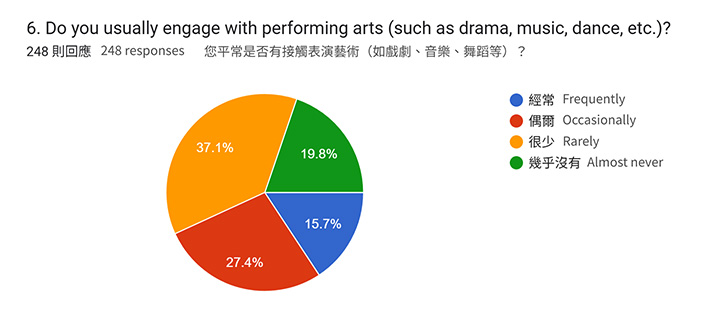
Most respondents had low exposure to performing arts. The largest group reported "rarely" (37.1%), followed by "occasionally" (27.4%). Only a small number said they "frequently" attended or experienced performing arts (15.7%), while 19.8% had almost no experience.
Part 2 About the Performance of One Thousand and Two Nights Questions 7–13
7Favorite Part of the Play
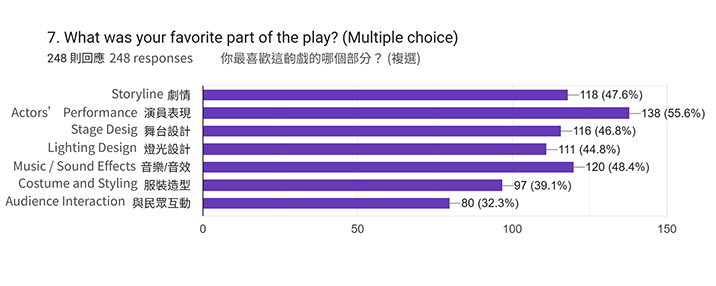
The audience's favorite part was the actors' performance, chosen by more than half of the respondents. Next were music/sound effects and the story, showing that both content and emotional expression were highly appreciated. In addition, technical aspects such as stage and lighting design also received fairly high ratings.
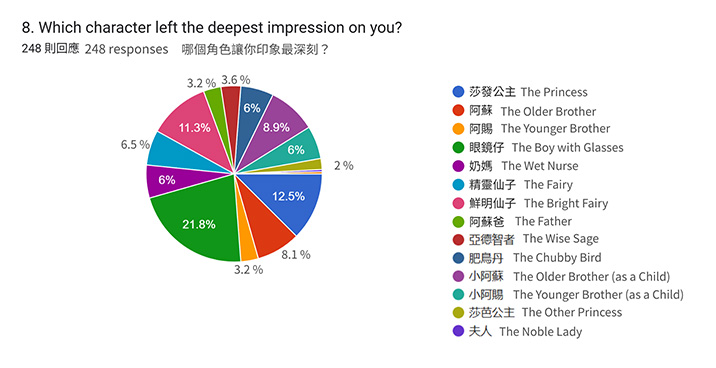
8Character That Left the Deepest Impression
The Boy with Glasses left the deepest impression on the audience, accounting for 21.8% of responses. Next were The Princess and The Bright Fairy. The results show a diverse distribution, indicating that the audience paid attention to and remembered different characters to varying degrees.
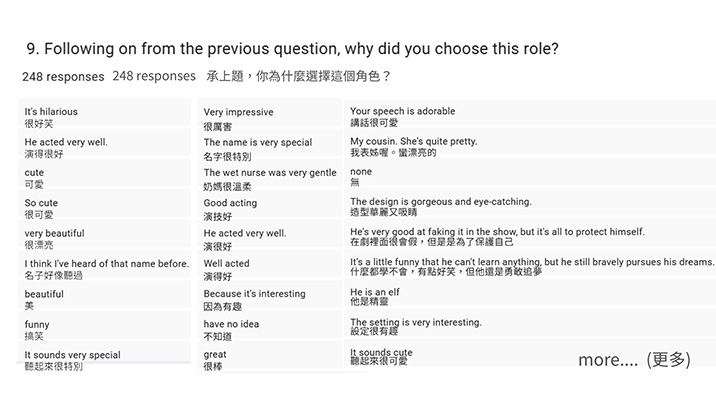
9Reasons Why Characters Left a Deep Impression
Most respondents mentioned that the characters were impressive because of their acting performance, while many also cited reasons such as being cute or funny.
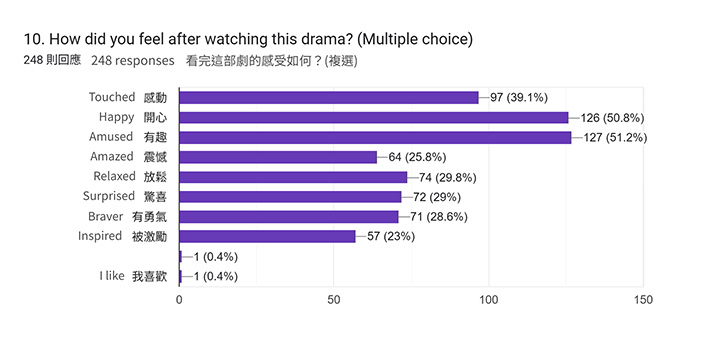
10Feelings After Watching the Performance
The most common feelings chosen were "fun" and "happy," making up more than half of the audience. In addition, nearly 40% of viewers said they felt "moved." Psychologically, feelings such as "relaxed," "surprised," "brave," and "inspired" were also reported by a significant portion of the audience. This shows that the performance not only provided entertainment but also had a positive emotional and motivational impact.
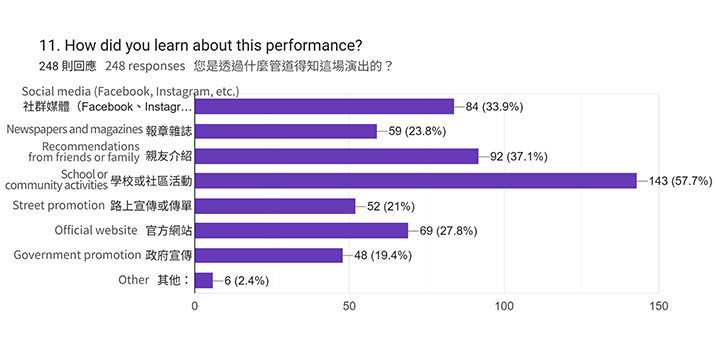
11How the Audience Learned About the Performance
Most viewers found out about the show through "school or community events," accounting for the largest share (57.7%). Next were "recommendations from friends or family" and "social media," showing that both personal networks and digital platforms play important roles in promoting the performance. Overall, using multiple channels together helped attract the audience and increased the visibility and reach of the show.
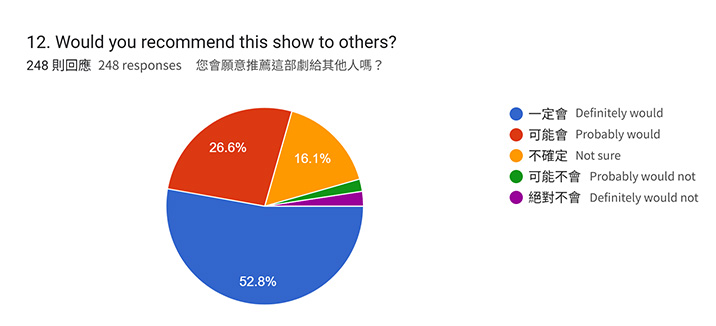
12Willingness to Recommend the Performance
The audience showed a high willingness to recommend the show, with "definitely would" and "probably would" adding up to 79.3%. This indicates strong overall satisfaction and good word-of-mouth potential. In general, the performance received positive and consistent feedback from viewers.
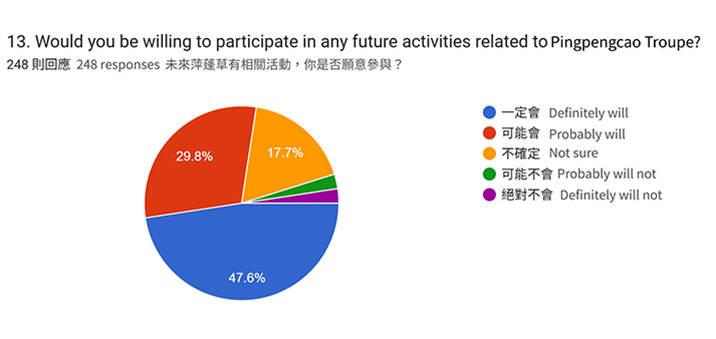
13Willingness to Participate in Future Pingpengcao Activities
Respondents showed a high willingness to join future Pingpengcao-related events. Nearly half (47.6%) said they "definitely would" participate, showing that most audience members have strong interest in the Pingpengcao brand and its activities. Another 29.8% chose "probably would," indicating potential interest, though their actual participation may depend on scheduling or the event content.
Part 3 Experiences and Opinions about Local Theater Troupes Questions 14–20
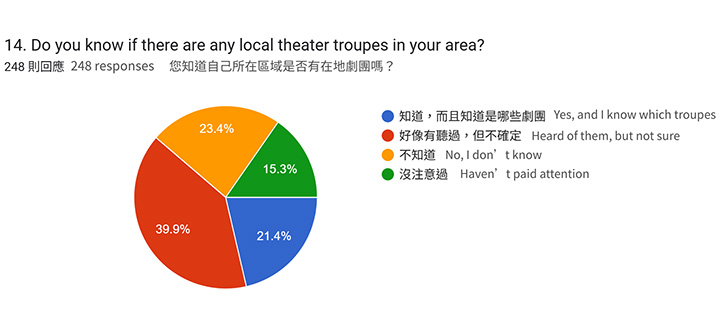
14Awareness of Local Theater Troupes
Awareness of local theater troupes is relatively low. Only 21.4% of respondents said they "know them and know which troupes they are." Most respondents lack specific information about local troupes, suggesting that promotion and visibility for local theater still have room for improvement.
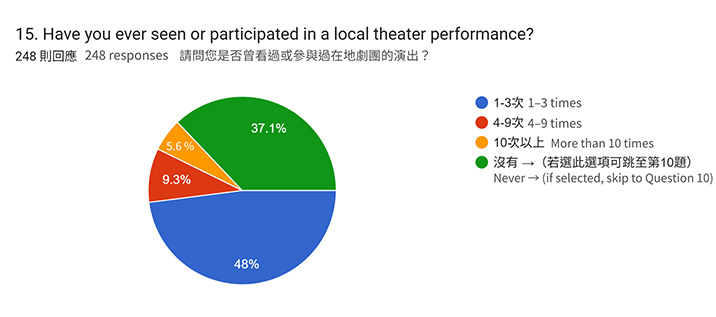
15Attendance or Participation in Local Theater Performances
48.0% of respondents have watched or participated in 1–3 local theater performances, showing that most people have had some initial exposure to local troupes. However, 37.1% said they have never watched or participated in local performances, reflecting that a significant portion of the public has not yet been reached by local theater activities, indicating potential for further promotion and development.
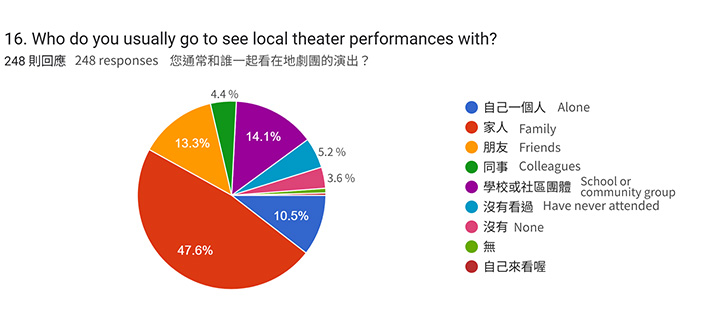
16Companions When Attending Performances
Family is the main companion group: 47.6% of respondents said they usually watch local theater performances with family, showing that local theater activities have a clear family-oriented characteristic. Social viewing comes next: 13.3% attend with friends, 4.4% with colleagues, and another 14.1% participate through school or community groups, indicating that some audience members see local theater as a social or group activity.
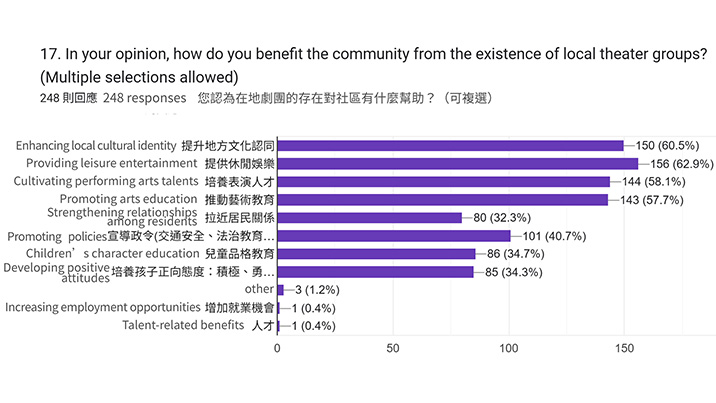
17Recognition of the Functions of Local Theater Troupes
Cultural and entertainment roles are the most recognized: over 60% of respondents believe local troupes can "provide leisure and entertainment" (62.9%) and "enhance local cultural identity" (60.5%), showing their importance in cultural life and community spirit. Educational and talent development roles are also notable: more than half of respondents acknowledge the troupes' role in "training performing talents" (58.1%) and "promoting arts education" (57.7%).
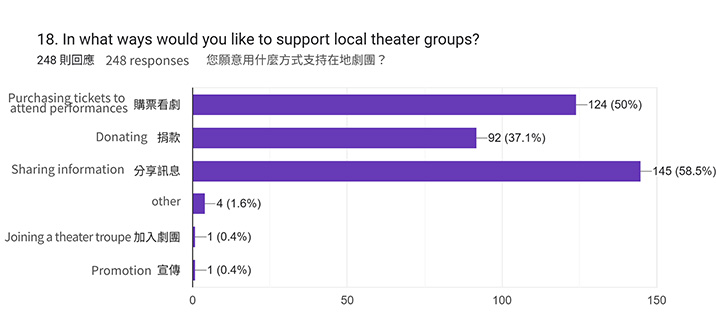
18Ways to Support Local Theater Troupes
Low-effort support is the most popular: over half of respondents are willing to support local troupes by "sharing information" (58.5%). Support through actual spending has a solid base: 50% are willing to "buy tickets to watch performances." Financial support is also notable: 37.1% said they are willing to "donate," providing direct economic support to local theater troupes.
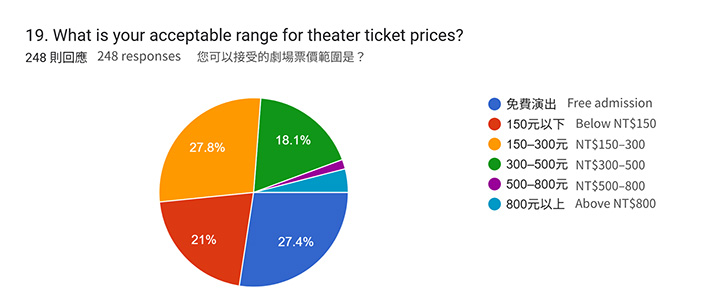
19Acceptable Ticket Prices
Most respondents prefer ticket prices in the "free" or "NT$150–300" range (together 55.2%), showing that affordable pricing meets public expectations. 18.1% are willing to pay NT$300–500, indicating that some audience members are open to paying a mid-range price for quality performances. Free performances remain attractive: 27.4% prefer free shows, reflecting that some viewers still need low-barrier opportunities to experience theater and develop viewing habits.
20Ways to Help Local Theater Troupes Improve
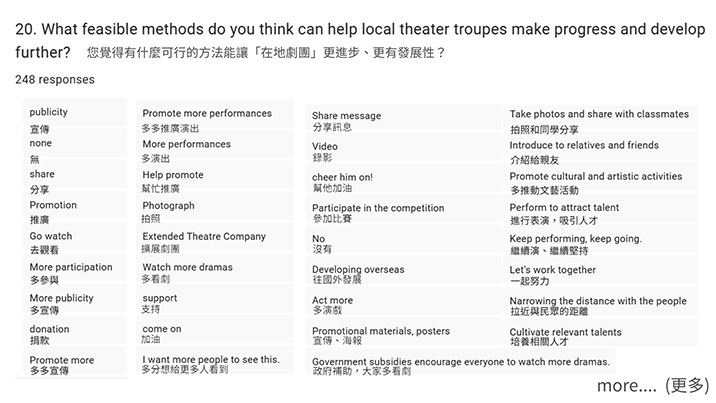
The main suggestion is to "strengthen promotion and visibility." Increasing the number of performances and opportunities for audiences to attend was also frequently mentioned. Some respondents specifically highlighted the importance of collaborating with schools.